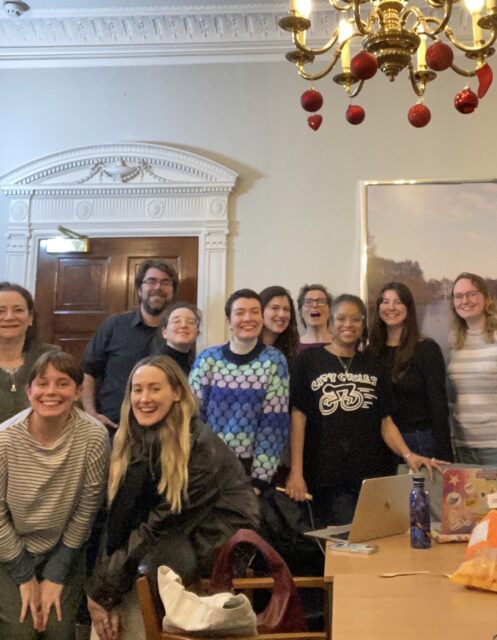
It’s taken a few weeks to process what happened at my first Wikipedia Edit-a-thon, but I’m finally ready to share a summary – with citations, of course.
(If you’re asking “What Wikipedia Edit-a-thon?”, here’s another blog for you. If you’re asking “What is a musical theatre bookwriter” here’s a Wikipedia article for you!)
On a cold January afternoon near Victoria Station, I brought together:
- 9 musical theatre bookwriters
- 2 Wikimedia community volunteers
- 15 doughnuts
- and one simple aim: to make women and non-binary Musical Theatre bookwriters more visible on Wikipedia.
So… what happened?
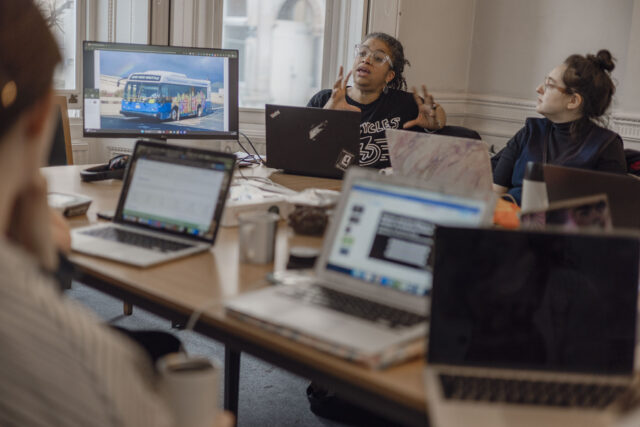
Firstly, we learnt a tonne of things from our two amazing trainers, Kelly and Liam. We connected with them through Wikimedia UK, who support the volunteer community that edits Wikipedia – and also trains trainers like them. They both gave up an afternoon to help us navigate our first Wikithon and support us through the overwhelm of our first edits, for which we were very grateful.
For starters, we learnt that the “Wiki” part of Wikipedia means “quick” in Hawaiian[1], that it holds more than 7 million articles in English, and that there were almost 40,000 active editors and 27 billion (yes, billion) page views in December 2025. Note to self: correct to 40,009 editors in January 2026…
We also discovered that over half of the biographical articles on Welsh Wikipedia are about women[2], thanks to the community of editors who are committed to achieving gender balance. On English Wikipedia the percentage of articles about women is closer to 20% – but there are several coordinated efforts reaching for gender balance that are nudging that dial ever upwards[3].
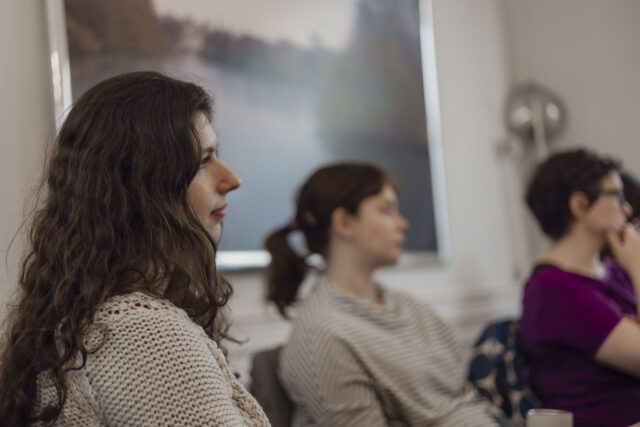
The stark truth is that if our sector isn’t properly represented on Wikipedia, it’s not just Wikipedia users who get a distorted view. Websites like Tate Modern take their information about artists directly from Wikipedia[4], as do music streaming services, while search engines and AI platforms increasingly draw on it for their answers. When the internet’s free encyclopaedia doesn’t accurately reflect our world, or the make-up of our creative sector, neither will the answers given out by ChatGTP and the like.
As we walked through the process of creating our first Wikipedia article, we learnt that every new page needs three things: Citations, citations and… citations.
Which leads onto the second thing that happened. We created and referenced a load of new biographies, and made a tonne of edits to pages that already existed.
Here’s our beautiful stats:

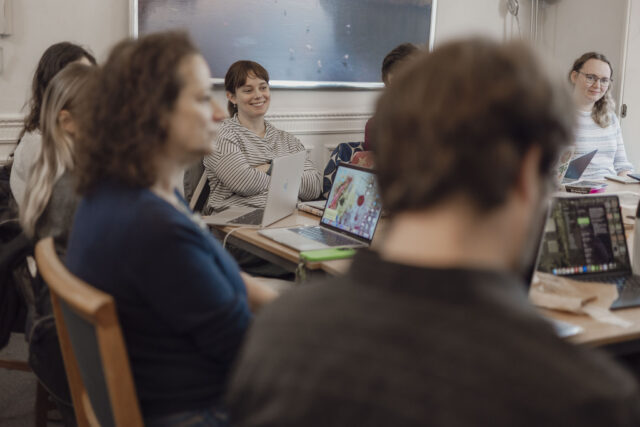
Between nine of us newbie Wikipedia editors, and two of the most encouraging trainers in existence, we made an epic 132 edits to 48 articles, and added nearly 6,000 words plus 70 solid references to the online encyclopaedia. Eight completely new articles about women and non-binary bookwriters now exist, where they didn’t exist before[5]. The cheer that went up across the room when the first new article was published was electric – and the donuts almost completely disappeared soon after.
If you’re wondering whose articles we created between us, you can now search on Wikipedia to find Freya Catrin Smith, Lauryn Redding, Laura Horton, Priya Parmar, Chinonyerem Odimba, Shauna Carrick, Beth Steel and Joanne Sydney Lessner, whose page (or lack of it…) started this whole Wiki-adventure for me. Anyone can add to any of these pages at any time, with references to match.
One of our new editors took it to another level after seeing Lauryn in a show the following week and (with permission!) took and uploaded a photo of them to improve their article. We are officially multi-media editors now!
We also updated pages for Alecky Blythe, Chris Bush, Vikki Stone, Maimuna Memon, Emma Vieceli and Morgan Lloyd Malcolm. Outside of biographies, we added Martha Geelan as the co-writer of Babies, and updated dozens of pages where links to our new articles needed to be added. By 5pm, we were feeling pretty proud of how much we had achieved. Until we looked back at our original list of 94 (yes NINETY FOUR) possible articles about women and non-binary musical theatre creatives that we had wanted to create. Baby steps, yes, but baby steps in the right direction. As a room full of professional writers whose entire working lives are usually spent leaping from deadline to deadline, we all had to adjust to a new way of thinking: There Is No Deadline. We can continue to make things better, one citation at a time.
The third thing that happened was a realisation of how few good quality, citable online references there are about women bookwriters, and non-male creatives in general. We hunted down as many journalistic articles, academic websites and independent sources as we could find, but so often there was just nothing accessible or suitable about the people we wanted to create an article about.
Sometimes it was because women and non-binary creatives were simply not included in high profile articles about our industry[6] – although sometimes resulted in very helpful rebuttal articles[7]. Sometimes it was because a website or article had fallen off the web, so the information we needed to reference wasn’t easy to find without knowing exactly what we were looking for and digging around in the Wayback Machine for it. Sometimes the only sources we could find would not be considered independent enough to cite on Wikipedia: a creative’s own website, or their agent’s, blurb on a venue website, a press release, programme note or promo piece written about a show.
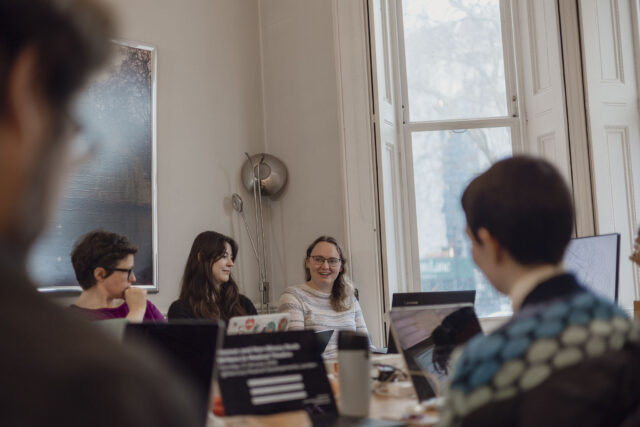
We moved through disappointment, to frustration, then onto anger, as we worked out that it’s really hard to create a solid article about an under-represented person when there are no accessible, independent sources to reference. We weren’t the first Wikipedia editors to stumble into this cul-de-sac of Catch 22s… There’s already a whole series of essays and loads of advice about exactly this issue[8][9][10].
We cannot reference what doesn’t exist!
So, if there’s one single action point to draw out from the day – apart from “editing Wikipedia is an excellent new hobby and we should all carry on doing it” – it’s to ask what can be done to get more solid, independent, citable source material written and shared online about our diverse community of musical theatre creatives. That might include easily accessible journalistic articles, reviews, academic papers, overviews and analyses of our sector… or maybe interviews? It wouldn’t be the first time that a press interview has become the only way to independently verify a fact that is true, but not yet verifiable enough for a Wikipedia page to be updated[11].
If you have any thoughts or ideas about how to get what we need out there, please let me and the team at Mercury Musical Developments know!
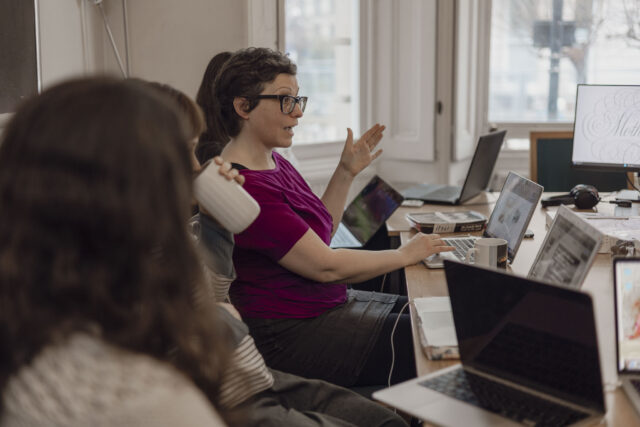
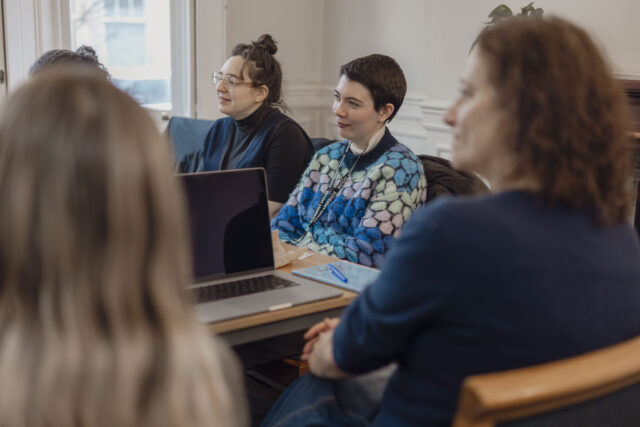
The final thing that happened was that we had a really fantastic afternoon. From catching up with everyone and hearing about how their own shows are progressing, to nerding out about the best shows we’ve seen recently – with a sidebar discussion of how to juggle musical theatre writing with a newborn. It was so validating to be in a room full of people working on shows that will one day put women and non-binary creatives centre-stage. But, as we know all too well, getting a musical from writing through to production can be a painfully slow process, and there are as many gatekeepers as there are opportunities out there. But on this one day in January, we found two places to focus our attention and meaningfully highlight women and non-binary creatives without waiting for someone else to give them a platform. Those two places were our afternoon of Wikipedia editing, and the MMD Open Mic Night at The Other Palace afterwards[12].
Going on from an Edit-a-thon to a Musical Theatre Open Mic Night was the perfect way to show that it’s possible to shine a light on our brilliant, diverse, creative and exciting industry in person – and online – and have a good time doing it.
Or, to paraphrase how one newly minted editor put it:
Hurray! Now I have even more ways to enjoy my favourite hobby:
Correcting people who are wrong on the internet!”
Want to join a future Musical Theatre Wikipedia Edit-a-thon? Or organise one wherever you are in the world? Or talk about how to get more independent citable sources online? Email me at hello@helenarney.com to start a conversation!
Huge thanks to the other musical theatre creatives who co-organised the event: Meg McGrady, Kate Marlais and Sarah Middleton, our Wikimedia trainers Kelly Foster and Liam Wyatt, and our five brave first-time editors Rosa, Emily Rose, Ellen, Rachel and Nikki. We’re extremely grateful to Mercury Musical Developments for loaning us their office to create The Room Where It Happened!
All photos by Lexi Clare, with kind permission and our thanks.
References:
- [1] – The origins of Wikipedia: https://en.wikipedia.org/wiki/History_of_Wikipedia
- [2] – Gender balance on Welsh Wikipedia: https://wikimedia.org.uk/2016/12/the-welsh-gender-equilibrium-welsh-becomes-the-biggest-language-wikipedia-to-achieve-gender-balance/
- [3] – Women In Red gender balance project: https://en.wikipedia.org/wiki/Wikipedia:WikiProject_Women_in_Red/Metrics/20%25_milestone
- [4] – Tate outsources website artist bios to Wikipedia: https://www.theartnewspaper.com/2018/09/10/tate-outsources-artist-biographies-on-its-website-to-wikipedia
- [5] – Why 8 new articles when the stats suggest it was 9? Because one article had three name variations, which got counted as separate pages, and one of the newly created pages slipped through our statistical net: https://outreachdashboard.wmflabs.org/courses/Mercury_Musical_Developments/Women_and_Non-Binary_Musical_Theatre_Bookwriters_Edit-a-thon_(12_January_2026)/articles/edited?newness=new
- [6] – “Why is there such a paucity of female writers in musical theatre?” Mark Shenton writing for The Stage: https://www.thestage.co.uk/opinion/why-is-there-such-a-paucity-of-female-writers-in-musical-theatre
- [7] – “Victoria Saxton: Where are the women who write musical theatre?” Rebuttal article in The Stage: https://www.thestage.co.uk/opinion/victoria-saxton-where-are-the-women-who-write-musical-theatre
- [8] – Writing Women into the encyclopedia: https://en.wikipedia.org/wiki/Wikipedia:WikiProject_Women_in_Red/Essays/Writing_women_into_the_encyclopedia
- [9] – A primer for creating women’s biographies: https://en.wikipedia.org/wiki/Wikipedia:WikiProject_Women_in_Red/Essays/Primer_for_creating_women%27s_biographies
- [10] – Writing about women on Wikipedia: https://en.wikipedia.org/wiki/Wikipedia:Writing_about_women
- [11] – A Totally Normal Interview With Author Emily St. John Mandel: https://slate.com/culture/2022/12/emily-st-john-mandel-divorced-wikipedia.html
- [12] – Mercury Musical Developments is great. If you write musical theatre, or want to, you should join! https://www.mercurymusicals.com/event/open-mic-night/